E2 Investor Visa: Which Legal Form Should I Choose?
Which Legal Form Should I Choose?
One of the first decisions to make when applying for an E2 investor visa is the legal form of the company to be founded, with which you will then apply for the visa. The choice of legal form in the USA can have significant effects on the level of taxation, both in the USA and in Germany. Which legal form is the "right" one depends on various factors.
Basically, we recommend forming a Limited Liability Company (LLC) or a Corporation (Corp., Inc.) due to the limitation of liability. However, it is important to mention that product liability in the USA is not linked to the liability limitation of the company, so it may be advisable to consult a lawyer here to minimize liability risks.
What Are the Differences Between Corporation and Limited Liability Company?

Corporation (Corp., Inc.)
The Corporation is comparable to a German AG. Shareholders are generally not personally liable for the company's obligations. There are so-called S-Corps and C-Corps. However, S-Corps are only available to US citizens, so we only deal with the C-Corp here. A Corporation must have a Board of Directors. Basically, a Corporation has the following bodies:
- President
- Vice-President
- Treasurer
- Secretary
One person can hold several or all of these positions. Unless otherwise specified, each of the above officeholders is a managing director.
A Corporation has share capital divided into various shares. The share capital can be set arbitrarily and does not need to be paid in. The number of shareholders in a Corporation is not limited. C-Corp shares can also be traded on the stock exchange.
A C-Corp is subject to corporate tax in the USA. At the federal level, the tax rate is currently (as of December 2020) 21%. Additionally, there may be corporate tax at the state level, e.g., currently 4.458% in Florida. State corporate tax rates in 2020 range from 0% to 12%.
The following overview map shows the different corporate tax rates in the individual states in 2020:
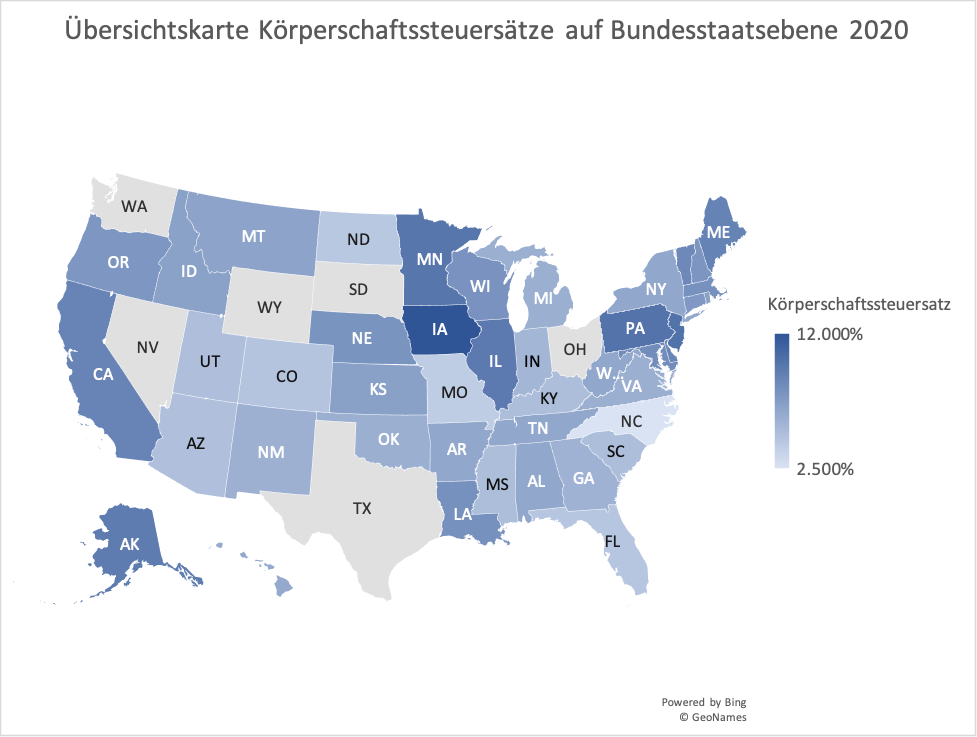
The gray states have no corporate tax at the state level but impose a gross receipts tax instead. Delaware and Oregon have a gross receipts tax in addition to corporate tax. Some states, like Pennsylvania, Virginia, and West Virginia, have a gross receipts tax at the municipal level but not at the state level.

Limited Liability Company (LLC)
An LLC is comparable to a German GmbH from a company law perspective. An LLC combines the characteristics of a Corporation with those of a Partnership. LLC members are not liable for the LLC's obligations. The management can be conducted by one or more members themselves or by an external manager. Members of an LLC can choose whether the LLC is taxed like a Corporation (subject to corporate tax) or as a Partnership (income distributed to members). Most US states allow the formation of a single-member LLC.
The LLC has no mandatory bodies but may appoint a manager who runs the LLC’s business. Otherwise, management lies with the members.
The LLC has no legally required share capital. The participation of members and the profit distribution between members is a purely private law agreement. An operating agreement is mandatory in California, New York, Missouri, Maine, and Delaware; in other states, it is optional. The operating agreement is not published. Share certificates can be issued, but these are not stocks; they only confirm the members’ contributions. For companies founded by us, we always provide share certificates, as banks require them for opening business accounts and the responsible consulate also demands proof of ownership relations regarding the visa application company.
Foreigners who are members of a US LLC must file an income tax return in the USA on US income. Whether profits must also be taxed again in the country of residence depends on the individual situation and the country of residence. Basically, it must be said that an LLC is not recommended for persons residing in Germany, as it can turn out to be a tax trap if the tax office classifies the LLC as a corporation.

LLC or Corporation?
If you live in the USA or plan to move there soon and do not expect any profits in the newly founded company until then, you can choose between LLC and Corporation. However, if you still live in Germany and expect profits, you should consider the Corporation.
Basically, we would recommend the C-Corporation as the best legal form for most clients. If, after a few years, the circumstances change, the structure can be adjusted again. The C-Corporation is a reliable legal form that has been well established for a long time. Although the tax burden appears higher at first glance compared to other legal forms, if you are starting a business, you usually do not expect high profits in the first years anyway. In terms of the reputation of the two legal forms in everyday life, there are no major differences.
For detailed and case-specific advice, we recommend consulting a tax advisor (CPA) and/or lawyer authorized in the respective state.
Disclaimer: This post does not constitute tax or legal advice but is solely intended for general information purposes.